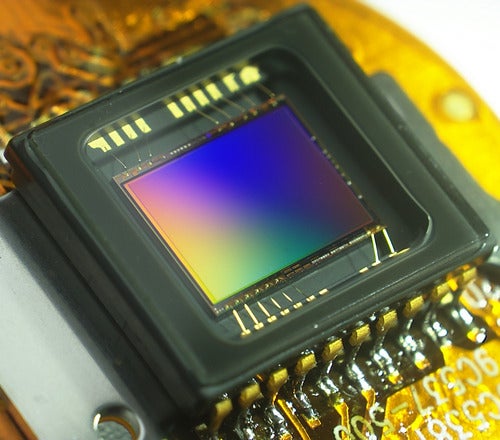
 |
| Well-behaved CMOS |
The n-type MOSFETs are arranged in a so-called "pull-down network" (PDN) between the logic gate output and negative supply voltage, while a resistor is placed between the logic gate output and the positive supply voltage. The circuit is designed such that if the desired output is low, then the PDN will be active, creating a current path between the negative supply and the output.
Could it be any clearer?
 |
| Sensor Sizes and Crop Factors |
Hardware and engineering issues aside, what is the big difference among sensors? Pixels, you say, and you'd be partially correct. Size, says someone else, and THAT is precisely the issue I have been wrestling with the past few months.
Below are the five sensors of most interest. Full frame refers to the size of the old 35mm image. There are larger sensors, but they cost $8,500 and up (body only). Even the FF cameras cost $1,500 and up. Let's focus on APS-C and smaller (well under $1,000)...
| Full Frame | 864 | |||
| APS-C (Sony A55) | 370 | 43% | ||
| MFT (Olympus E-M10) | 225 | 26% | 61% | |
| 1" (Nikon 1, Sony RX10) | 116 | 13% | 31% | 52% |
| 1/2.3" (Canon SX50) | 28 | 3% | 8% | 12% |
My first digital SLR was the Sony SLT-A55 which has an APS-C sensor. This sensor is 43% the size of a full frame sensor. Quite a bit smaller, but we've got a long way to go.
The Nikon 1 and the Sony RX10 use a 1" sensor for their mirrorless interchangeable lens type cameras. This sensor is only 13% the size of a FF sensor, but we STILL got a ways to go.
The Canon SX50 and many point-and-shoot cameras use a 1/2.3" sensor, which is about the size of your little fingernail. This sensor is just 3% the size of a full frame sensor, 8% the size of an APS-C and 12% the size of Micro Four Thirds. Yet you can make decent 16x20 prints from the results and the images are fine for web viewing, particularly if uncropped.
Finally, because that is where I am headed, is the Micro Four Thirds sensor developed by Olympus and Panasonic. This sensor is 26% the size of a full frame sensor and 61% the size of an APS-C sensor but over 8 times the size of the Canon SX50. MFT allows for lighter and smaller equipment all the way around. A nice compromise in my view.
By now your mind is probably reeling, as is mine. Discuss among yourselves and we'll continue in the next post...
By now your mind is probably reeling, as is mine. Discuss among yourselves and we'll continue in the next post...

No comments:
Post a Comment