Tuesday, December 9, 2025

THE EVOLUTION OF AN IMAGE

Not even the great Ansel Adams was able to create an image with nothing but a camera (not to mention, a phone!). We see, we notice, we react, we record. And then the magic begins…

For pictures with a lot of red and white, there is no better place than Canada. Most folks have never heard of Gaspe, in the province of Quebec. It is on the eastern seaboard of the Atlantic, and is the possible site of the first interactions between North American indigenous peoples and Europeans, most likely the Vikings (11th century). So, it has lots of history and lots of beautiful landscapes, and is a popular stopping off point for cruise ships. We were there in October of 2016, on a so-called “Northeast Color Tour”. There isn’t a better description of the area.

The image to the right was our first view of what we assume was some sort of weather monitoring equipment. The sun was bright, and so were the colors on this small building. A photographer’s dream.


Minimalism 101 teaches us that one of our first considerations before taking a photo is perspective. Is the subject below, above, to the left, to the right, or straight on. A straight-on perspective with perpendiculars perpendicular and horizontals horizontal will often be the most minimalistic perspective, although modern photo editing software can do some really amazing straightening after the fact. It is just easier if you can do most of that before the image is captured. You may note that the sign to the right of the building has been removed, and the colors saturation increased, particularly in the sky, which all leads to a more eye-catching image. But… is that all there is? Could it be cropped even move? Moving on…


While the sky is brilliant, for this image it is a distraction, an element that could (and should) be removed. Version 3 is a crop of nothing but the building, and conveys a much more minimalist point of view. But, could we go deeper? What is the really interesting thing in this photo? The door, of course, moving on…


Now we have the essence of the scene. Brilliant color, simple geometry, with just a doorknob and the small hinges to remind us of where we started. Many of the imperfections in the wood were removed, which leads to a more minimalist image at the expense of losing some of the character of the door.

Tuesday, July 22, 2014

Jeepers Creepers, Where'd Ya Get Those Peepers? Part 3.

EUREKA!

Quick show of hands: how many of you use protective UV filters on your lenses?

I'm going on 45 years of using interchangeable lens cameras, and have bought the old saw that it's better to break a filter than the front element of your lens, and there is no degradation caused by a filter.

Right.

Except with a Sigma 120-400mm f/4.5-5.6 APO DG HSM telephoto at full zoom.

To recap (more here and here): I had some unexpected results when comparing a micro four thirds camera (Olympus OM-D E-M10) and an APS-C camera (Sony A77II). All I wanted to know was, how much difference is there between MFT and APS-C. I was surprised that the smaller sensor E-M10 images appeared to be sharper than the larger APS-C sensor images (more on sensors here). But, I was trying to recreate a realistic shooting environment by handholding and using a fairly fast shutter speed. I decided that I needed to be a little more disciplined if just good image quality was my sole objective.


So, I repeated all my tests using a tripod. With image stabilization enabled. And, with image stabilization disabled (as recommended by the manufacturer). And, using the self-timer to further reduce the possibility of causing camera shake when pressing the shutter release. And, oh, my, did I ever get some weird results with the A77II. There were some kind of strange artifacts present when stopped down to f/11. Like a double exposure or something. And, it got worse at f/16! The mystery deepened.


I was ready to blame the lens and throw it under the bus, figuratively speaking. Then, in the middle of the night, it hit me - there was one other variable: the freaking "protective" UV filter that cost all of about $5 sitting in front of my almost $1,000 lens. I know, I know, it is so close to the lens it should cause no discernible degradation of the image.Well, surprise, mateys. It does. And, here's the proof:


Without Filter and With Filter
I would not have believed it if I hadn't seen it with my own two eyes. Multiple times. After doing some research, I've found that you can pay close to $100 for a "good" filter, so maybe that's my problem - a $5 Tiffen just isn't a match for a Hoya or better. In the mean time, however, I think I'll just go filterless.

And, I can get back to comparing MFT to APS-C!

Aye, lassies an laddies, we've uncovered t'culprit, an 'is name be Tiffen...

Monday, July 21, 2014

Jeepers Creepers, Where'd Ya Get Those Peepers? Part 2.

The saga continues...

Previously on Jeeper Creepers: A young lad in North Dakota discovers the allure of photography when he finds his father's Kodak "Pocket" camera and learns about aperture and shutter speeds by opening the back of the camera and watching what happens when the shutter release is pressed (more here). Later he graduates to a Brownie Hawkeye, then a 35mm rangefinder, and then a SLR with interchangeable lenses. He is hooked...

In my last post, I described some unexpected results when comparing a micro four thirds camera (Olympus OM-D E-M10) and an APS-C camera (Sony A77II). It might be fairer to say I am comparing lenses, namely, the Olympus M.Zuiko 75-300mm f/4.8-6.7 II MSC ED zoom and the Sigma 120-400mm f/4.5-5.6 APO DG HSM. All I wanted to know was, how much difference is there between MFT and APS-C. I got more than I bargained for...

In my earlier comparisons I was surprised that the smaller sensor E-M10 images appeared to be sharper than the larger APS-C sensor images (for more on sensors, click here). But, I was trying to recreate a realistic shooting environment by handholding and using a fairly fast shutter speed. I decided that I needed to be a little more disciplined if just good image quality was my sole objective.

I tried a number of things, with use of a tripod probably being the most important. Although, quite frankly, with the image stabilization built in to both the E-M10 body and the A77II body, I'm not sure it really made that much difference, particularly when using shutter speeds of 1/500 sec and faster. Still, using a tripod took the camera shake variable out of the picture (pardon the pun). Even with a tripod, however, there are a couple of other considerations, which we will explore as we go along.

First let's agree on some fixed constant. Most photographers would agree that the best image quality should be at some aperture other than wide open (subject to spherical aberrationcoma and astigmatism) or closed down to the minimum (diffraction reduces sharpness). It's simple physics. A lens can not be optimized across its entire surface, so in almost all cases the optimum image quality is somewhere in the middle aperture range, in fact usually one or two stops smaller than the maximum in order to allow the most light possible while providing the optimum lens corrections. For example, here is the difference between f/6.7 and f/11 on the E-M10:


Olympus 75-300mm f6.7 vs f/11 @300mm (100% crop)
F/16 looks marginally better, but interestingly f/22 is less sharp. As the lens approaches its smallest opening diffraction rears its ugly head and IQ suffers. For our purposes let's stay at f/11.

So, how much difference does a tripod make? When I compare the Olympus handheld shot at 1/2000 sec against a tripod shot at the same f stop but a shutter speed of 1/500 sec, I see virtually no difference at max zoom (300mm). I would hope I never shoot at any less than 1/500 sec except for extreme cases. However, for the sake of argument, let's compare the shots on a tripod. Oops. We already did. The comparison shots above were taken on a tripod.

Next comes the argument that shooting on a tripod can be worse UNLESS you disable the IS (image stabilization) feature. I have seen some pretty extreme examples - supposedly any movement is picked up by the IS and an anti-movement adjustment mechanism goes into a loop, picking up the movement caused by the mechanism. I don't see this with these two cameras.

So, we are down to lenses, or more properly, the Sigma lens. Here is just the Sigma compared at max aperture (f/5.6) and close to optimum (f/11):


Sigma 120-400mm f/5.6 vs f/11 @400mm (100% crop)
There is some kind of strange aliasing going on in the f/11 shot. Like a double exposure or something. And, it gets worse at f/16! The mystery only deepens...

Any suggestions? The only thing I can think to do is get my hands on another 400mm and see what kind of results I get.

Monday, July 14, 2014

Jeepers Creepers, Where'd Ya Get Those Peepers?

No, I am not a peeping Tom. A peeping Chuck, perhaps.

Yes, I am in danger of becoming a "pixel peeper". A pixel peeper is someone who magnifies photographs on a computer screen to critically evaluate image resolution at the pixel level. However, it is commonly used as a derogatory remark as explained in the Urban Dictionary.

Late in April, shortly after receiving my new Olympus OM-D E-M10, I was doing some comparison of image quality and came up with the following shocking sample. Note that the sharpest image seems to be from an old Canon SX50 with a 1/2.3" sensor, not the APS-C Sony A55 or the new Micro Four Thirds Oly. (SX50 on the left, then E-M10 and A55 - you may have to click on the image to see the difference) A fluke, you might say. I might agree. Unfortunately I didn't have time at the time to pursue the issue (closing up in Florida and heading back to KC), and now the SX50 is gone (took an unfortunate dip in the lake) and the A55 is also gone (upgraded to an A77 M2). So, back to the drawing boards


It is just too weird to think that a super small sensor could yield images comparable to APS-C or MFT, so I decided to concentrate on a comparison between the E-M10 and the brand spanking new A77 M2. Results have been different from my first attempt, but are still puzzling. Even though having a smaller sensor than A77 (MFT is 61% the size of APS-C), the E-M10 appears to have significantly better sharpness. What the heck?

 I started by setting both cameras up to what I considered to be a typical configuration for sailing or birding shots: shutter preferred and fairly fast (1/1000 or faster), medium ISO (greater than 200 but less than 1,000), which would probably mean shooting most of the time wide open, maximum aperture. I ended up using a shutter speed of 1/1600, ISO 400 and max aperture on a Sigma 70-400mm (f/5.6) and the Olympus 150-300mm f/6.7. And, this is what I got:


Again, you may have to click on the image to see the difference, but just look at the window frames and I think you'll agree that the E-M10 images are sharper. So, thinks I, lenses typically aren't at their best wide open, let's stop down a couple stops. And this is what I got (f/11):


Not much difference, is there? Note that I cranked the ISO up to 1600 in order to stop down and from a noise standpoint there isn't much difference compared to the original ISO 400 shots.

Oh, dear. What can the matter be? Well, we all know that zoom lenses are not at their best at maximum zoom, so I backed both lenses down to the 35mm equivalent of 300mm (instead of 600mm). Results? Not that much different:


What is left to explain this phenomenon? A 300mm vs a 400mm lens? Brand name lens vs independent? 

My plan is to clamp these babies on a tripod even though I probably won't do that very often in reality. Any insight into this dilemma will be greatly appreciated... 

Update: I failed to mention that the images above were 100% crops of these windows.

Wednesday, May 28, 2014

Why We Photograph

Why do we photograph? Is it the process? Or is it the results? Personal use? To share with the world? Profit? Recognition? A way to kill time? Capture memories? What is it for you?

Do you want to display on a TV. Post online? Print? 4x6 inches? 4x6 feet? 

I can not answer these questions completely. A little bit of everything perhaps? The reason I am even asking the questions is that I'd like to concentrate my photo time on one camera system, and right now I have three.


First there is the Canon SX50, basically a point-and-shoot, but with a 50x optical super-zoom lens. An incredible 24mm-1200mm equivalent. Unfortunately autofocus can be very slow and the sensor size is miniscule, just 3% the size of a full-frame 35mm sensor.

Recently I acquired an Olympus OM-D E-M10, a mirrorless DSLR-like camera. With a 600mm equivalent telephoto, this system weighs about half as much as an actual DSLR, even an APS-C sensor size. The Oly has a Micro Four Thirds sensor which is 26% the size of a full-frame 35mm sensor. Still not very large, but much larger than the sensor in the SX50.

My first DSLR was, and is, a Sony SLT-A55, upon which I usually have a Sigma 120-400mm zoom (600mm equivalent). Its APS-C sensor is a little less than half the size of a full-frame 35mm sensor.

Three powerful systems. Three completely different size sensors. And, of course, three completely different uses.

Now you may have a glimmer of understanding why I'd like to answer the question: why do I photograph?
SX50

If the answer is to just post photos to be viewed on a computer screen, or perhaps make 4x6 or 8x10 prints, the Canon SX50 is probably all I'll ever need (although Sony has a 63x optical zoom!). Here is an example of what the SX50 is capable of. Hand-held, 1/640 second, 1200mm equivalent: 

If portability with maximum image quality is the goal, then the E-M10 is the camera of choice. 

If the absolute maximum image quality is the priority then the A55 is the choice, unless, of course, I go out and get a full-frame camera!

Questions, questions, questions, and so few answers...

In my next post I give some possible answers.

Thursday, April 17, 2014

When The Moon Hits Your Eye...

like a big piece of pepperoni pizza pie, it is Blood Moon Eclipse time. Actually, this was the first of  a lunar eclipse "tetrad": a series of four consecutive total lunar eclipses that happen at about six-month intervals. The next one is due Oct. 8, followed by blood moons April 4, 2015, and Sept. 28, 2015, unless, of course, you believe Texas televangelist pastor John Hagee, who sees the four blood moons as evidence of a future "world-shaking event" that begins to fulfill End Times prophecy. In which case, too bad. No more eclipses for you.

Blood Moon Eclipse, April 15, 2014
While I have more to say about sensors, we interrupt this blog to bring you the Blood Moon Eclipse of April 15, 2014.

First, my disclaimer: while I do own a tripod, it is not a very good one, so I don't use it very often; to compensate for this I took all my photos at 1/1000 of a second, which was fine until the full eclipse (more on this later); I used three different cameras, with three different sensors, ranging from the 1/2.3" Canon SX50 to the Micro Four Thirds Olympus OM-D E-M10, to the APS-C Sony SLT-A55. The SX50 has an amazing 50x optical zoom, giving the equivalent of a 1200mm telephoto in 35mm terms. Both the E-M10 and the A55 had the equivalent of 600mm teles

The image quality of the results with all three cameras was unexpected, and a little disappointing. The small sensor won, hands down. Maybe not in other situations, but for this particular experience, it was the better camera.

To check image quality (IQ), I used ACDSee Pro 7 and its Compare function to place images side by side and then magnify them. Generally I compared just two images in order to get the most magnification, but occasionally I'd do three or four at a time whenever I had a bunch of images that were more or less the same. Below is an SX50 to E-M10 comparison.


Remember that the E-M10 sensor is a little more than 8 times the size of the SX50. One more disclaimer: since the SX50 maximum optical zoom is 1200mm and the E-M10 max is 600mm, the E-M10 image is magnified twice as much. Still, with a sensor that is 8 times larger I expected a noticeable difference in favor of the E-M10. Not to be. The SX50 image has more apparent grain (noise), but to my eye is definitely sharper. Last disclaimer: all images were jpg format, no post processing sharpening. Some day when I have nothing better to do, I may try post processing both files. Right...

So, while I hate to become a "pixel peeper", the results of this experience were discouraging. I even (gasp) considered returning the E-M10 and saving my money for a full frame DSLR.

Nah, too damn heavy for an old guy like me. Gotta figure out how to make the E-M10 work for me, one way or another (or, just use the SX50!)...

May your nights be cloudless and bright.

Monday, April 14, 2014

Making Sense Of Sensors

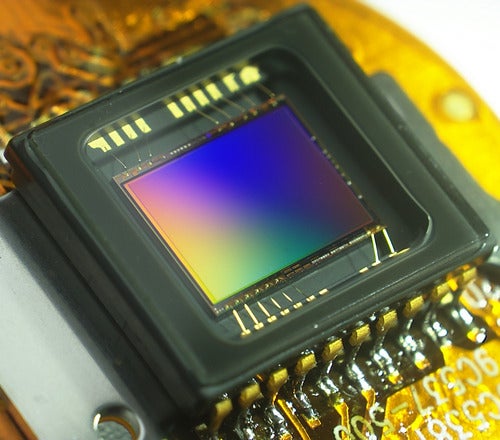
Well-behaved CMOS
The heart of the digital camera is the sensor, the device that converts an optical image into an electronic signal. Currently used types are semiconductor charge-coupled devices (CCD) or the very well-behaved complementary metal–oxide–semiconductor (CMOS) or N-type metal-oxide-semiconductor (NMOSLive MOS). You're probably wondering how they work, and even if you aren't you're going to find out anyway. From Wikipedia:
The n-type MOSFETs are arranged in a so-called "pull-down network" (PDN) between the logic gate output and negative supply voltage, while a resistor is placed between the logic gate output and the positive supply voltage. The circuit is designed such that if the desired output is low, then the PDN will be active, creating a current path between the negative supply and the output.

Could it be any clearer?
Sensor Sizes and Crop Factors

Hardware and engineering issues aside, what is the big difference among sensors? Pixels, you say, and you'd be partially correct. Size, says someone else, and THAT is precisely the issue I have been wrestling with the past few months.

Below are the five sensors of most interest. Full frame refers to the size of the old 35mm image. There are larger sensors, but they cost $8,500 and up (body only). Even the FF cameras cost $1,500 and up. Let's focus on APS-C and smaller (well under $1,000)...


Area in mm% of Full Frame% of APS-C% of MFT
Full Frame864
APS-C (Sony A55)37043%
MFT (Olympus E-M10)22526%61%
1" (Nikon 1, Sony RX10)11613%31%52%
1/2.3" (Canon SX50)283%8%12%

My first digital SLR was the Sony SLT-A55 which has an APS-C sensor. This sensor is 43% the size of a full frame sensor. Quite a bit smaller, but we've got a long way to go.

The Nikon 1 and the Sony RX10 use a 1" sensor for their mirrorless interchangeable lens type cameras. This sensor is only 13% the size of a FF sensor, but we STILL got a ways to go.

The Canon SX50 and many point-and-shoot cameras use a 1/2.3" sensor, which is about the size of your little fingernail. This sensor is just 3% the size of a full frame sensor, 8% the size of an APS-C and 12% the size of Micro Four Thirds. Yet you can make decent 16x20 prints from the results and the images are fine for web viewing, particularly if uncropped.

Finally, because that is where I am headed, is the Micro Four Thirds sensor developed by Olympus and Panasonic. This sensor is 26% the size of a full frame sensor and 61% the size of an APS-C sensor but over 8 times the size of the Canon SX50. MFT allows for lighter and smaller equipment all the way around. A nice compromise in my view.

By now your mind is probably reeling, as is mine. Discuss among yourselves and we'll continue in the next post...