Thursday, April 17, 2014

When The Moon Hits Your Eye...

like a big piece of pepperoni pizza pie, it is Blood Moon Eclipse time. Actually, this was the first of  a lunar eclipse "tetrad": a series of four consecutive total lunar eclipses that happen at about six-month intervals. The next one is due Oct. 8, followed by blood moons April 4, 2015, and Sept. 28, 2015, unless, of course, you believe Texas televangelist pastor John Hagee, who sees the four blood moons as evidence of a future "world-shaking event" that begins to fulfill End Times prophecy. In which case, too bad. No more eclipses for you.

Blood Moon Eclipse, April 15, 2014
While I have more to say about sensors, we interrupt this blog to bring you the Blood Moon Eclipse of April 15, 2014.

First, my disclaimer: while I do own a tripod, it is not a very good one, so I don't use it very often; to compensate for this I took all my photos at 1/1000 of a second, which was fine until the full eclipse (more on this later); I used three different cameras, with three different sensors, ranging from the 1/2.3" Canon SX50 to the Micro Four Thirds Olympus OM-D E-M10, to the APS-C Sony SLT-A55. The SX50 has an amazing 50x optical zoom, giving the equivalent of a 1200mm telephoto in 35mm terms. Both the E-M10 and the A55 had the equivalent of 600mm teles

The image quality of the results with all three cameras was unexpected, and a little disappointing. The small sensor won, hands down. Maybe not in other situations, but for this particular experience, it was the better camera.

To check image quality (IQ), I used ACDSee Pro 7 and its Compare function to place images side by side and then magnify them. Generally I compared just two images in order to get the most magnification, but occasionally I'd do three or four at a time whenever I had a bunch of images that were more or less the same. Below is an SX50 to E-M10 comparison.


Remember that the E-M10 sensor is a little more than 8 times the size of the SX50. One more disclaimer: since the SX50 maximum optical zoom is 1200mm and the E-M10 max is 600mm, the E-M10 image is magnified twice as much. Still, with a sensor that is 8 times larger I expected a noticeable difference in favor of the E-M10. Not to be. The SX50 image has more apparent grain (noise), but to my eye is definitely sharper. Last disclaimer: all images were jpg format, no post processing sharpening. Some day when I have nothing better to do, I may try post processing both files. Right...

So, while I hate to become a "pixel peeper", the results of this experience were discouraging. I even (gasp) considered returning the E-M10 and saving my money for a full frame DSLR.

Nah, too damn heavy for an old guy like me. Gotta figure out how to make the E-M10 work for me, one way or another (or, just use the SX50!)...

May your nights be cloudless and bright.

Monday, April 14, 2014

Making Sense Of Sensors

Well-behaved CMOS
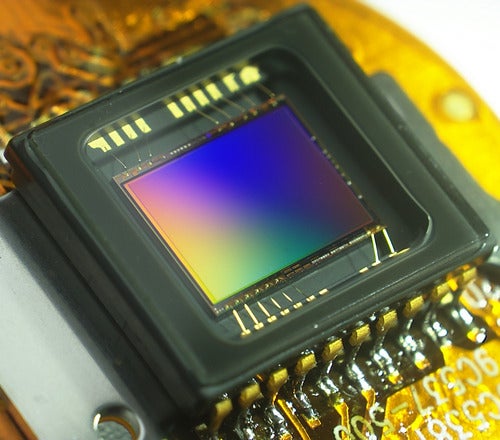
The heart of the digital camera is the sensor, the device that converts an optical image into an electronic signal. Currently used types are semiconductor charge-coupled devices (CCD) or the very well-behaved complementary metal–oxide–semiconductor (CMOS) or N-type metal-oxide-semiconductor (NMOSLive MOS). You're probably wondering how they work, and even if you aren't you're going to find out anyway. From Wikipedia:
The n-type MOSFETs are arranged in a so-called "pull-down network" (PDN) between the logic gate output and negative supply voltage, while a resistor is placed between the logic gate output and the positive supply voltage. The circuit is designed such that if the desired output is low, then the PDN will be active, creating a current path between the negative supply and the output.

Could it be any clearer?
Sensor Sizes and Crop Factors

Hardware and engineering issues aside, what is the big difference among sensors? Pixels, you say, and you'd be partially correct. Size, says someone else, and THAT is precisely the issue I have been wrestling with the past few months.

Below are the five sensors of most interest. Full frame refers to the size of the old 35mm image. There are larger sensors, but they cost $8,500 and up (body only). Even the FF cameras cost $1,500 and up. Let's focus on APS-C and smaller (well under $1,000)...


Area in mm% of Full Frame% of APS-C% of MFT
Full Frame864
APS-C (Sony A55)37043%
MFT (Olympus E-M10)22526%61%
1" (Nikon 1, Sony RX10)11613%31%52%
1/2.3" (Canon SX50)283%8%12%

My first digital SLR was the Sony SLT-A55 which has an APS-C sensor. This sensor is 43% the size of a full frame sensor. Quite a bit smaller, but we've got a long way to go.

The Nikon 1 and the Sony RX10 use a 1" sensor for their mirrorless interchangeable lens type cameras. This sensor is only 13% the size of a FF sensor, but we STILL got a ways to go.

The Canon SX50 and many point-and-shoot cameras use a 1/2.3" sensor, which is about the size of your little fingernail. This sensor is just 3% the size of a full frame sensor, 8% the size of an APS-C and 12% the size of Micro Four Thirds. Yet you can make decent 16x20 prints from the results and the images are fine for web viewing, particularly if uncropped.

Finally, because that is where I am headed, is the Micro Four Thirds sensor developed by Olympus and Panasonic. This sensor is 26% the size of a full frame sensor and 61% the size of an APS-C sensor but over 8 times the size of the Canon SX50. MFT allows for lighter and smaller equipment all the way around. A nice compromise in my view.

By now your mind is probably reeling, as is mine. Discuss among yourselves and we'll continue in the next post...

Friday, April 11, 2014

Triptyching the Light Fantastic - Part 2

First things first, "tripping the light fantastic" commonly, and quite literally, is to dance nimbly or lightly, or to move in a pattern to musical accompaniment. However, it is sometimes used to refer to just plain having fun or, back in the day (60s) it could refer, again quite literally, to tripping, or using some sort of hallucinatory substance (I know you know what I'm talking about). 

So, bite me if the first thing I thought of when I thought of triptych was this phrase. And, now that I look at it, perhaps I am talking about "light" in the photographic sense. It really doesn't matter. It is a "secret about a secret" (Diane Arbus).


But, I digress. Back to the triptych...

Separate images, variants on a theme

A triptych is a work of art (usually a panel painting) that is divided into three sections, or three carved panels which are hinged together and can be folded shut or displayed open. The triptych form arises from early Christian art, and was a popular standard format for altar paintings from the Middle Ages onwards. A triptych may consist of separate images that are variants on a theme, or may be one larger image split into three, or may be the same image captured at different times.

Same image,
different times

I first though about a triptych or at least some sort of multiple photo image while editing some shots from the North Shore of Hawaii. In order to catch a wave at its peak, splash, droplets and all, I did some continuous shutter release or burst mode. While I got the peak, I also got other interesting aspects of the wave approaching and breaking. To convey all of that I combined the shots into one photo. And, I liked it. Same spot, just different times. Oh, and I liked it both horizontal and vertical. Your choice.

Al E. Gator

Then on to this week and Mr. Al E. Gator. I struggled to get something of interest from a single shot, and at first ended up with a close crop of just the head, and then a black and white transform to better show the details of the jaw and bumpy skin.


But I wanted to show the whole gator, but in a new way, hence - gator triptych. The thing is that now you can kind of focus on one part at a time or gather in the whole gator. I like it. How about you?

One image, split into three
For a real trip, try reading Ed Kashi's comments regarding his book, THREE. Okay, okay, an true artist has passion, but sometimes Ed gets a little carried away for my taste.

In the next post we'll get back to the amazing OM-D E-M10, although I am perplexed. Actually, a little disappointed although I'm not done exploring the subject, so to speak, quite yet...

Thursday, April 10, 2014

Triptyching the Light Fantastic

Okay, one more little timeout from the exploration of the Olympus OM-D E-M10...

I had to "work" yesterday, which for me consists of riding a golf cart around a beautiful golf course, interacting with the (mostly) happy golfers and admiring the views. Since this particular golf course (Serenoa Golf and Country Club) literally has water on every hole, there is a vast variety of wildlife, from gators to ospreys, eagles, herons, egrets, ibis and the occasional white pelican.

I fixed up my lunch "cooler" into a nice little camera storage container so I always have a camera near by. Yesterday there was a good sized alligator sunning itself on the left side of number 12. Since it was a fairly light day customer wise, and no one was coming up the fairway, I stopped and grabbed a few shots even though I currently only have a 12-50mm (24-100mm 35mm equivalent) lens (75-300mm/150-600mm should be here today - yay!).

I was able to get within about 10 feet before I saw some sign of movement. I quickly set my shutter release options to Sequential L (low speed, 3.5 frames per second) in hopes I could get a series of Mr. Al E. Gator either going into the pond, or coming after the crazy guy with the funny black box in his hands. In a twinkling he (or she) was gone and I was left with nothing but this...


Now, believe it or don't, but gator shots are pretty much a dime a dozen (or, less) in Florida, so I started thinking about how to make this shot something special.

My first thought was a close cropping, thus ---

Still much to common an image for Florida, although you can now easily see those chompers that rest outside of his mouth, and see how knobby his skin is.


My next thought was --- BLACK & WHITE. Oh, yeah. Better, but still left me wanting. Somehow I wanted the whole body in the image in order to convey all aspects of being a gator. Before long I thought of trying a triptych, and now that you see where we are going, we'll explore that subject in the next post...